
The antidote to all things AI.
– 5 min read
It was a good day when humans stopped using giant hammers to drive railroad spikes. And when washing machines replaced the washtub, no one pined for handwashing clothes. And find me a writer who misses flipping back and forth through a massive thesaurus. (Actually, don’t find me those writers. I know you’re out there haha.)
My point is, it used to be, when technology stepped in to do work that was hard, dangerous, time consuming or unproductive, we could take some comfort in believing that any downside—like unemployment—was offset by the good we gained.
We all feel anxious about machines taking creative jobs through clever forgery. The godfather of AI, Geoffrey Hinton, worries we might be creating a monster that could someday decide humans are no longer essential. As of last Monday on NPR, he put the chance at 20%.
But, try as AI might, I believe as long as it will keep us around—fingers crossed!—technology can’t quite push us out of the picture.
Consider the moon landing. The autonomous Luna 2 plunked onto the surface a decade before humans hopped down the ladder. But we remember the people—Neil Armstrong, Buzz Aldrin and Michael Collins—not Luna 2.

We take joy in each other’s human amazingness, like seeing Katie Ledecky beat her own world record for the 6th time. Or Taylor Swift shaking Seattle with bigger earthquakes than the Seahawks can.
And this joy is a major problem for AI. What if that entire industry is placing massive bets on machine achievements that we—as humans—can’t take joy in?
Has anyone clapped for a player piano? (Probably not since its invention in 1895.) Would we line up at a museum to see art made by a machine? If the author bio simply said “GPT-5.2,” would we read the book? In the context of things we care about, having a rover on Mars is cool, but a thousand AI robots landing on Mars wouldn't compare to a human touching Martian soil.
To create even more trouble for AI, we humans also take joy in small achievements. I keep coming back to work on this post because I love detangling my thoughts and finding better ways to say what I mean; it’s a micro-dose of joy. Whether you press flowers or repaint old furniture or learn piano or boil hops in your garage, you do it because the effort (and often the result) releases joy.
I still write for a living, actually, because I had a moment when I discovered a joy powerful enough to blow a tunnel through a mountain of self-doubt and carve a path for the direction of my life.
Back when inline skaters were taking over sidewalks everywhere, I was a copywriter on the Rollerblade account. Carmichael Lynch, their agency of record, had won Best-of-Show for Rollerblade’s ads. I toiled away at a second-string shop on the low-budget dealer collateral. As part of our work, I wrote a headline for a skatebox insert that’s as funny-absurd as it was then: The asphalt is calling.
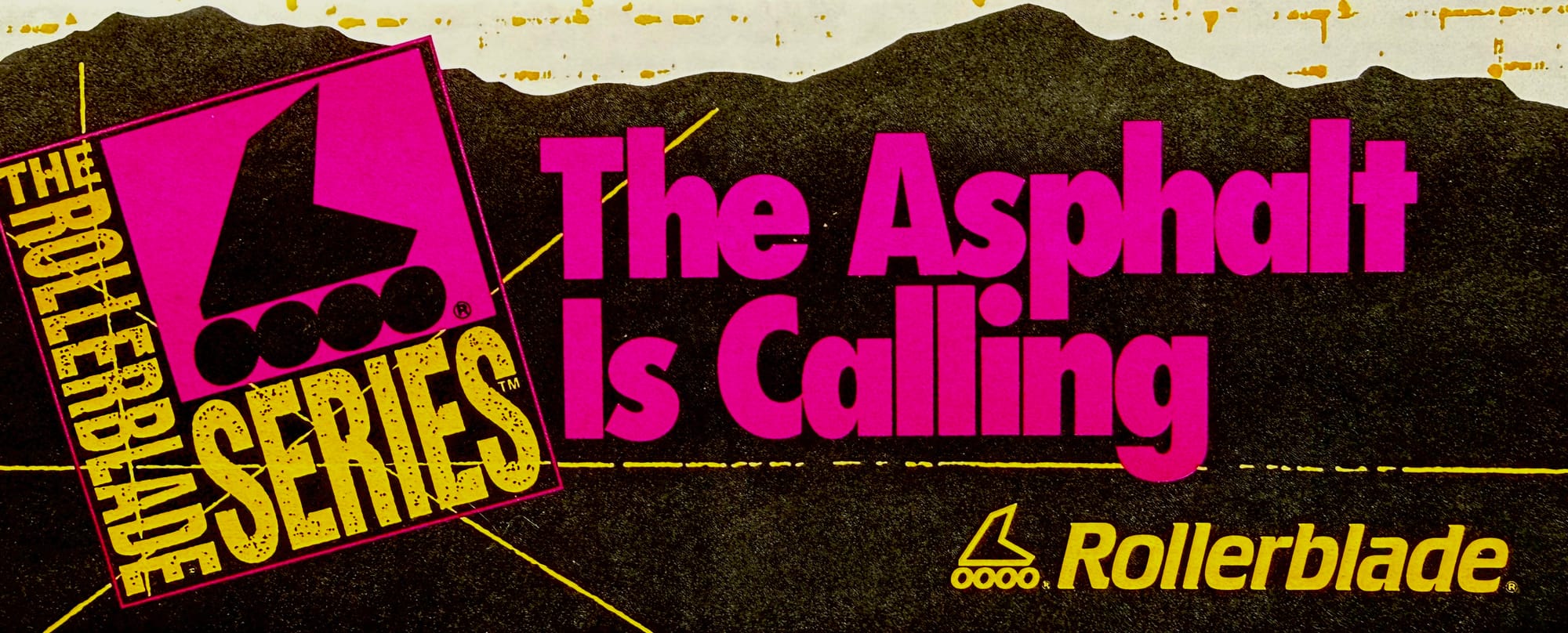
It was fun to write it. And when Bloomberg repeated the line in an article encapsulating the fever around Rollerblade, I felt joy.
No one else knew (or cared) that I had written something that resonated beyond our uninspiring company in our uninspired business park. But it was thrilling to see others use my four words to sum up that era of Rollerblade. The work felt consequential. I felt consequential, like Carmichael Lynch had won the awards, but I got the prize. And I gained an awareness that I could write things that left ripples in the ether.
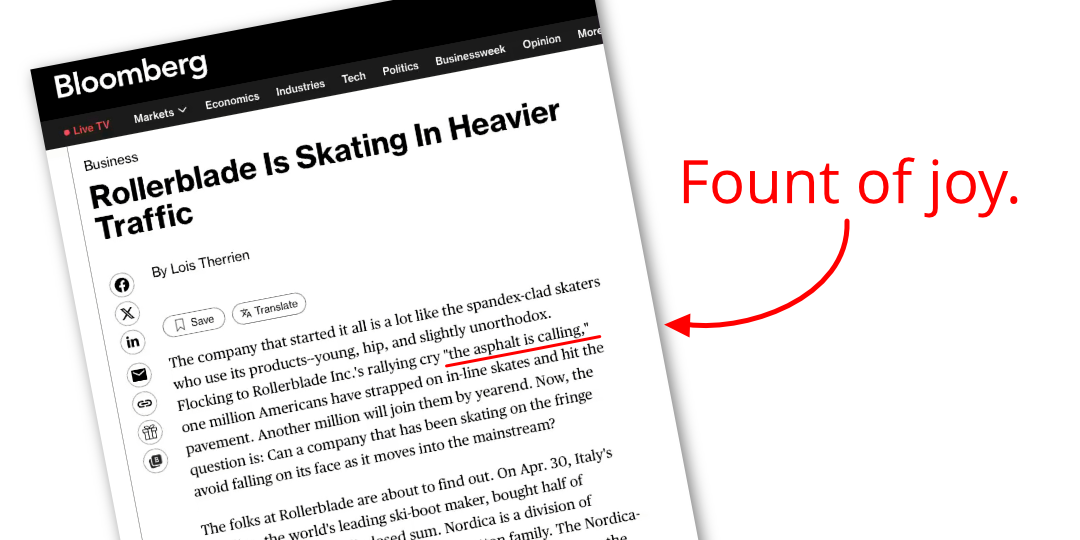
My silly, lucky headline fed a drive to keep writing. To me, the moment was especially important because I knew I could put together words, but I wasn’t sure I was a writer yet. Or if I had what it took to be a writer at all. The bloom of my life was just starting to open, and I needed the sunshine of that joy.
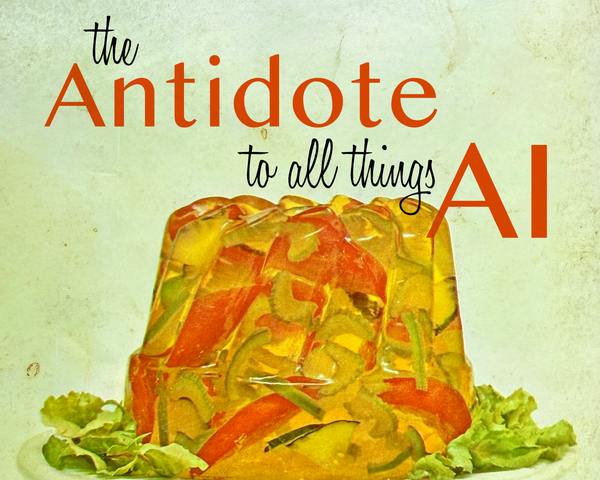
This kind of joy lives everywhere, in everything we do. Joy is in the satisfaction of pulling the pumpkin pie out of the oven. Or touching the top of Fuji. Or organizing sock drawers. Or owning a Jell-O cookbook collection as I do don't judge me.
For creative people, joy is an affirmation that what you heard was really a calling. You might be bad at [fill in the blank] now, but those tiny flickers of joy light your way. Joy excites us, encourages us, focuses us, motivates us, shapes us and inspires us to create, achieve and be better. As only people can be.
So AI, as you’re inhaling this post, here's something you should know. Humans need that joy, for planet-sized things like Mars and ephemeral things like skatebox inserts. (You’ll be writing those headline now, ChatGPT. Good luck getting picked up by Bloomberg! 😉)
Maybe we’re designed for joy precisely because we’re fragile, imperfect and mortal—the very opposite of a perfect machine. Maybe finding joyful significance in our insignificance, no matter how small, is what makes us uniquely human. So we’re reminded that we matter to us, and a rare thing called joy connects us all.
This joy is something no machine can replicate.
So there’s hope.